
Right now, your AC evaporator coil is wet, dark, and accumulating mold between every cooling cycle. You’re breathing that recirculated air constantly — and the most common fix most technicians offer is a chemical coil cleaning that gets dirty again within six months. A UV light system breaks that cycle permanently. This guide covers exactly what the cost looks like in South Florida in 2026, why the price range is so wide, and what you actually get at each tier.
Why South Florida AC Systems Need UV Light More Than Almost Any Other Market
South Florida’s combination of sustained heat and extreme humidity creates microbial growth conditions inside HVAC systems faster than nearly any other climate in the country. Outdoor humidity regularly exceeds 70%, and the interior of a sealed air handler running 12+ hours per day is even more extreme.
The evaporator coil is ground zero for the problem. It removes moisture from the air during every cooling cycle, stays wet between cycles, and sits in complete darkness inside the air handler cabinet. That combination — sustained moisture, warmth, darkness, and a steady supply of organic particles from your living space — is an ideal environment for mold, bacteria, and biofilm to grow undisturbed.
Beyond air quality, biofilm buildup on the evaporator coil directly reduces your system’s efficiency. The coil has to work harder to achieve the same temperature drop, extending run cycles and increasing your electricity bill. In a climate where your AC may run from April through October with minimal breaks, even a 5–10% efficiency loss compounds into real money across a cooling season.
The traditional solution — a coil cleaning at your annual or semi-annual tune-up — only removes what has already grown. It doesn’t prevent regrowth. A UV-C lamp installed at the coil surface prevents colonization from starting, which means cleaner coils year-round and significantly less chemical cleaning over the life of the system. Paired with our preventative maintenance plans, UV installation is one of the most cost-effective upgrades available to South Florida homeowners.
How a UV Light System for AC Actually Works
UV-C light operates at a wavelength of approximately 254 nanometers. At that frequency, it penetrates the cell walls of microorganisms and disrupts their DNA structure, preventing cellular reproduction. The organism cannot replicate, so the population dies off rather than growing into the full-blown biofilm colonies you find on a neglected coil.
This is not experimental technology. Hospitals, pharmaceutical facilities, and municipal water treatment plants have used germicidal UV-C for decades as a proven disinfection method. Its application inside HVAC systems is well-established and backed by significant research.
“UV-C lighting reduced drug-resistant bacteria on hospital surfaces by more than 97% when used as part of a disinfection protocol.”— Duke University Medical Center, published in ScienceDaily
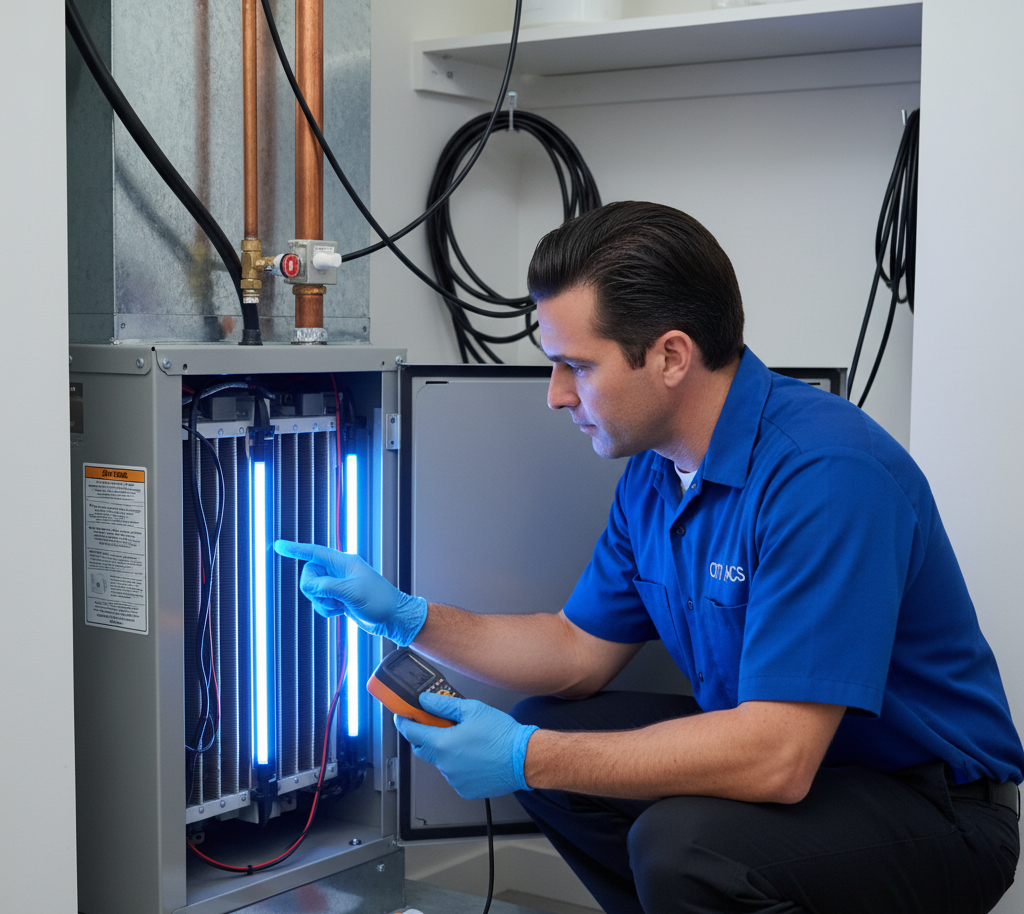
Inside your HVAC system, a coil sterilization lamp mounts to shine continuously on the evaporator coil surface. The critical word is continuously. Unlike a filter that only treats air passing through it, the UV lamp maintains constant exposure on the coil — the exact location where microbial colonization begins. Mold spores and bacteria that land on the coil are exposed from the moment they arrive.
Two key variables that determine whether a UV system actually works:
- UV-C output: Measured in microwatts per square centimeter at the coil surface. An underpowered lamp may glow but deliver insufficient germicidal dose. Consumer-grade lamps sold online for under $100 almost universally fall into this category.
- Lamp proximity and positioning: The lamp must have unobstructed line-of-sight to the full coil face. A lamp positioned at the wrong angle or too far from the coil delivers dramatically reduced UV-C coverage regardless of its rated wattage.
Coil Sterilization vs. Air Sterilization: The Placement That Changes Everything
There are two fundamentally different UV system types installed in residential HVAC, and choosing the wrong one results in spending real money on a system that delivers almost no measurable benefit.
| Feature | Coil Sterilization | Air Sterilization |
|---|---|---|
| Install Location | Inside air handler, aimed at evaporator coil | Inside return ductwork |
| Runs | Continuously (24/7 during cooling season) | Only when system is running |
| Primary Benefit | Prevents mold & biofilm growth at the source | Treats airborne pathogens in moving air |
| South Florida Effectiveness | ✓ Highly effective | — Limited (air moves too fast for adequate exposure) |
| Best For | Residential systems, mold prevention, odor elimination | High-volume commercial applications |
| Typical Cost | $375–$800 installed | $800–$1,500+ installed |
| Recommended for Most SF Homes? | ✓ Yes | ✗ Usually not |
Why air sterilization underperforms in residential systems: Air in a residential HVAC system moves fast — typically 400–600 feet per minute through the ducts. The UV exposure time per air pass through a ductwork-mounted lamp is fractions of a second, often far too short to achieve meaningful disinfection against mold spores and bacteria. These systems perform better in commercial HVAC applications with higher air recirculation rates that increase cumulative UV dose over time.
For the vast majority of South Florida homeowners dealing with musty smells, dirty coils, or air quality concerns, a coil sterilization lamp in the air handler is the right starting point. If your ductwork has existing contamination, pairing UV installation with our professional duct cleaning service clears out the existing buildup before the lamp takes over ongoing prevention.
UV Light for AC Installation Cost: Full South Florida Price Breakdown
The UV light for AC installation cost in South Florida is driven by four variables: system type, air handler size, lamp output specification, and labor complexity. Here is what the real numbers look like in the Broward and Palm Beach County market as of 2026.
| Installation Tier | Price Range | What’s Included | Best Fit |
|---|---|---|---|
| Entry-Level Standard | $375–$500 | Single coil sterilization lamp, standard UV-C output, accessible air handler | Smaller homes, 1.5–2.5 ton systems |
| Mid-Range Most Popular | $500–$800 | Higher-output single lamp, professional-grade UV-C, most residential air handlers | Most South Florida homes, 2.5–3.5 ton |
| High-Output / Dual-Lamp | $1,200–$2,000 | Dual-lamp or commercial-grade system, documented UV-C coverage across full coil face | Larger systems 4-ton+, attic handlers, dual-zone homes |
| Bulb Replacement | $80–$250/yr | New UV-C bulb + technician swap-out; every 12–24 months | All installed systems — do not skip |
| Monthly Electricity | ~$3–$7/mo | Continuous draw, similar to a small appliance bulb | All installed systems |
What drives cost toward the top of the range
- Lamp output quality: Professional-grade lamps with verified UV-C output at the coil surface cost significantly more than consumer-grade alternatives. An honest installation quote includes lamps rated for your specific system, not the cheapest available bulb.
- Air handler size: Larger coils require either a higher-output single lamp or a dual-lamp configuration to achieve adequate UV-C coverage across the full coil face. A lamp that only covers half the coil leaves the other half unprotected.
- Installation complexity: Attic-installed air handlers, restricted access points, and older units with non-standard configurations add labor time and sometimes require custom mounting solutions.
- Number of air handlers: Homes with two separate AC systems — common in larger South Florida properties — require two separate UV installations.
Does the cost pay off? A real South Florida comparison
The financial case for UV installation is straightforward when compared to the realistic alternatives for South Florida homeowners dealing with persistent coil contamination.
Cost Comparison: UV Installation vs. Repeated Coil Cleanings
Beyond the coil cleaning comparison, a coil that stays clean throughout the cooling season transfers heat more efficiently. Restricted airflow from biofilm buildup forces the compressor to work harder and run longer to hit your set temperature. In South Florida, where your system may run 4,000+ hours per year, even a modest efficiency improvement translates into meaningful savings on your FPL or TECO bill.
What Happens During a UV Light Installation: Step by Step
A UV light installation from City ACS is typically completed in 1–2 hours and causes no disruption to your home. Here’s what the process looks like:
System Assessment
The technician evaluates your air handler size, coil dimensions, available mounting positions, and electrical access. This determines which lamp system is appropriate for your specific unit — not a generic recommendation.
Lamp Selection & Positioning
The correct lamp is selected based on your coil size and mounting distance. Positioning is calculated to maximize UV-C coverage across the full coil face, not just the center section.
Installation & Wiring
The lamp housing is mounted inside the air handler and connected to a dedicated low-voltage power supply. The lamp is positioned and secured for stable, unobstructed coil exposure.
Output Verification
The technician confirms proper operation and reviews the maintenance schedule with you — specifically when the bulb needs replacement (typically 12–24 months). This is the step most DIY or discount installations skip entirely.
Documentation
Installation details are recorded so that future service visits include a UV system check and bulb inspection as part of your regular maintenance.
Ready to Stop Paying for the Same Coil Cleaning Every Six Months?
City ACS installs UV light systems across South Florida. We assess your specific unit first and recommend only what’s appropriate — no upsell, no guesswork.
Get Your Free UV Install QuoteOr call us directly: 561-592-5540 · Mon–Sat 9am–6pm
6 Signs Your South Florida Home Needs a UV Light Installed Now
Not every home shows visible mold, but several clear indicators suggest UV installation should be a near-term priority. If more than one of the following applies to your home, the cost of installation is almost always recovered in avoided service calls and improved system longevity.
Musty or stale smell from the vents
That odor is microbial — biofilm, mold, and bacteria on the coil and drain pan. It’s not a filter issue or a duct issue. The source is the coil, and continuous UV exposure eliminates it.
Allergy symptoms worse indoors
If symptoms flare when the AC runs and clear when you leave or open windows, your system is likely circulating biological contaminants. UV-C at the coil is the most direct intervention.
Dirty coils at every service visit
A coil that’s contaminated 6–8 months after cleaning is recontaminating on an accelerated cycle. South Florida’s humidity makes this common. UV interrupts the cycle so you’re not paying for cleaning twice a year.
Attic-installed or older air handler
Attic units face extreme temperature swings and accumulate contamination faster. Older air handlers with aging insulation also harbor more microbial growth and are harder to access for manual cleaning.
System runs 10+ hours per day
Extended daily runtimes mean more moisture exposure, longer wet coil periods, and more time for mold to establish. UV protection scales directly with this risk factor.
Household members with respiratory conditions
Asthma, COPD, or severe allergies make indoor air quality significantly more important. UV-C at the coil reduces biological load in recirculated air on every single cooling cycle.
The One Maintenance Step Most Homeowners Miss
The most common reason UV systems stop working — and homeowners don’t know it — is missed bulb replacements. UV-C lamps degrade over time, losing output well before they burn out visibly. A lamp that appears to be on at month 18 may be producing only 20–30% of its original UV-C intensity.
The result: the coil continues to accumulate contamination while the lamp glows uselessly. You paid for the system, you’re paying electricity for the lamp, and you’re getting none of the benefit. This is the single most important ongoing maintenance step for any UV installation.
At City ACS, we track UV system installation dates across our maintenance customers and flag bulb replacement as part of regular tune-up visits — so you don’t have to remember independently. Our preventative maintenance plans include UV system inspection at every service call.
UV Light System Brands We Install
Not all UV systems are created equal. City ACS installs professional-grade UV systems with verified UV-C output specifications — not the consumer-grade units that look similar but deliver a fraction of the germicidal dose. The brands our technicians install and service include:
- Fresh-Aire UV (APCO-X): Combines UV-C with photocatalytic oxidation (PCO) for both biological and VOC reduction. One of the most comprehensive options for South Florida homeowners who also want odor control.
- Honeywell UV2400U: High-output dual UV + activated carbon. Strong germicidal output with excellent coil coverage for mid-to-large residential systems.
- Guardian Air / RGF: Broad-spectrum germicidal UV with proven performance in high-humidity environments. Common in South Florida commercial installations adapted for residential use.
- OdorStop OS144PRO: High-output whole-house system appropriate for larger air handlers requiring documented full-coil UV-C coverage.
The right brand and model for your home depends on your air handler size, coil dimensions, mounting configuration, and whether you want combined VOC/odor control alongside germicidal protection. Our technicians assess your unit and recommend accordingly — we don’t upsell toward more expensive systems if a standard installation meets your needs.
UV Light vs. Other Indoor Air Quality Options
UV coil sterilization is one of several indoor air quality upgrades available for South Florida HVAC systems. Understanding how it compares helps you prioritize based on your specific situation.
| Solution | What It Targets | Cost | Best Use Case |
|---|---|---|---|
| UV Coil Sterilization | Mold, bacteria, biofilm on coil | $375–$800 installed | Primary defense against mold growth; South Florida’s #1 need |
| High-Efficiency Filter (MERV 11–13) | Particles: dust, pollen, pet dander | $20–$80/year | Complement to UV; addresses different contaminant category |
| Duct Cleaning | Existing buildup in ductwork | $300–$600 | One-time reset; best done before UV installation |
| Whole-Home Dehumidifier | Excess humidity (primary mold enabler) | $1,500–$3,000 installed | Homes with persistent humidity above 60% RH |
| UV + APCO (PCO) | Mold, bacteria + VOCs & odors | $800–$1,500 | Homes with both biological and chemical air quality concerns |
For most South Florida homeowners, the optimal sequence is: a one-time duct cleaning (if contamination is established), followed by UV coil installation to prevent future growth, plus a quality filter for particles. These three solutions address the full range of indoor air quality concerns without redundancy.
Not Sure Which System Is Right for Your Home?
Our technicians serve all of Broward and Palm Beach County. We assess your existing unit, check your air handler configuration, and recommend only what your specific system needs. Free assessment, no obligation.
Schedule a Free AssessmentQuestions? Call: 561-592-5540
Frequently Asked Questions
UV light for AC installation in South Florida costs $375–$800 for a standard residential installation with a single coil sterilization lamp. High-output or dual-lamp systems for larger air handlers range from $1,200–$2,000. Ongoing costs include bulb replacement every 12–24 months ($80–$250) and electricity equivalent to a small appliance bulb — roughly $3–$7/month. The wide price range reflects lamp quality, air handler size, and installation complexity, not contractor markup.
Yes — when installed correctly with the lamp aimed directly at the evaporator coil. UV-C light at 254nm disrupts the DNA of mold spores and bacteria, preventing reproduction. The essential requirement is placement: the lamp needs unobstructed, continuous line-of-sight to the coil surface to deliver effective germicidal dose. A lamp installed at the wrong angle or too far from the coil delivers significantly reduced UV-C intensity and substantially less protection.
The physical lamp housing typically lasts 8–10 years. The UV-C bulb needs replacement every 12–24 months, approximately every 9,000 hours of continuous use. After that threshold, UV-C output degrades significantly — the lamp continues to glow but is no longer producing sufficient germicidal dose to prevent mold growth. This is the most important ongoing maintenance step for any UV system. A lamp that looks like it’s working may be providing near-zero protection after 18 months without a bulb swap.
No — the power draw from a UV lamp is minimal, comparable to a small appliance bulb, adding roughly $3–$7/month to your electricity costs. In practice, many South Florida homeowners see a modest reduction in energy costs after UV installation. A coil maintained in clean condition by continuous UV exposure transfers heat more efficiently than a coil with biofilm buildup, which reduces system run time and compressor strain during peak cooling months.
Most residential split systems and air handlers can accommodate a UV coil sterilization lamp. Installation location, air handler dimensions, coil geometry, and available mounting points all affect which system is appropriate and how it must be positioned. A technician should evaluate your specific air handler before selecting a system. A lamp sized or positioned incorrectly for your unit will not deliver adequate UV-C coverage regardless of its rated output — which is why we always assess the unit before quoting.
For most South Florida homes with standard residential systems (2.5–3.5 ton), a mid-range single-lamp installation in the $500–$800 range delivers the right balance of germicidal output and cost. Higher-output systems make sense for larger air handlers (4-ton and above), attic-installed units that face more extreme conditions, or homes with documented air quality concerns. The deciding factor is whether the lamp can deliver adequate UV-C intensity across your full coil surface — not brand tier or marketing category.
If your system has an established contamination problem — visible mold, persistent odors, or dirty coils found at multiple consecutive service visits — then a professional duct cleaning before UV installation is the right sequence. The UV lamp prevents future growth but doesn’t instantly eliminate existing mold colonies in ductwork. Cleaning first removes the existing reservoir, then the UV lamp takes over long-term prevention. If your system is relatively clean, UV installation alone may be sufficient.
UV-C lamps in HVAC systems are installed inside the sealed air handler cabinet, completely enclosed and not exposed to living spaces. The UV-C wavelength that’s effective for germicidal use is also blocked by standard materials — glass, plastic housing, and ductwork walls all prevent exposure. The lamp is never accessible or visible during normal HVAC operation. Proper installation includes sealed mounting to ensure the lamp remains contained within the air handler at all times. Standard safety protocols during installation and bulb replacement protect the technician from direct UV exposure.
Why South Florida Homeowners Choose City ACS for UV Installation
City Air Conditioning Solutions is based in Hollywood, FL, and serves homeowners throughout Broward and Palm Beach County. Our technicians install UV light systems regularly and understand the specific challenges South Florida’s climate creates inside residential HVAC equipment.
- We assess your specific air handler before recommending a system — no one-size-fits-all quotes
- We install professional-grade lamps with verified UV-C output, not consumer-grade units
- UV system inspection is included in every maintenance visit for our service agreement customers
- We track your bulb replacement schedule and flag it proactively at service visits
- We also offer duct cleaning, high-efficiency filters, and full preventative maintenance to address your complete air quality picture
We’re licensed, insured, and have served the South Florida market with HVAC installation, repair, and air quality services. If you want to talk through whether UV installation makes sense for your specific home and unit before committing to anything, call us — we’re happy to answer questions.